Your Miranda v arizona case summary images are available. Miranda v arizona case summary are a topic that is being searched for and liked by netizens now. You can Download the Miranda v arizona case summary files here. Download all free photos and vectors.
If you’re searching for miranda v arizona case summary images information related to the miranda v arizona case summary keyword, you have visit the right blog. Our site always provides you with suggestions for downloading the maximum quality video and image content, please kindly search and locate more informative video articles and graphics that match your interests.
Miranda V Arizona Case Summary. The Arizona Supreme Court. 2d 694 1966 Brief Fact Summary. Miranda Vs Arizona 1966 is a consolidation of four cases tried in the United States Supreme Court the decision of the Court on the issue of rights under Fifth amendment is regarded as a landmark judgement of its time it is by far the most cited case in American Criminal Proceedings History. September 2nd 2014 I.
 Miranda V Arizona 1966 Tutor2u From tutor2u.net
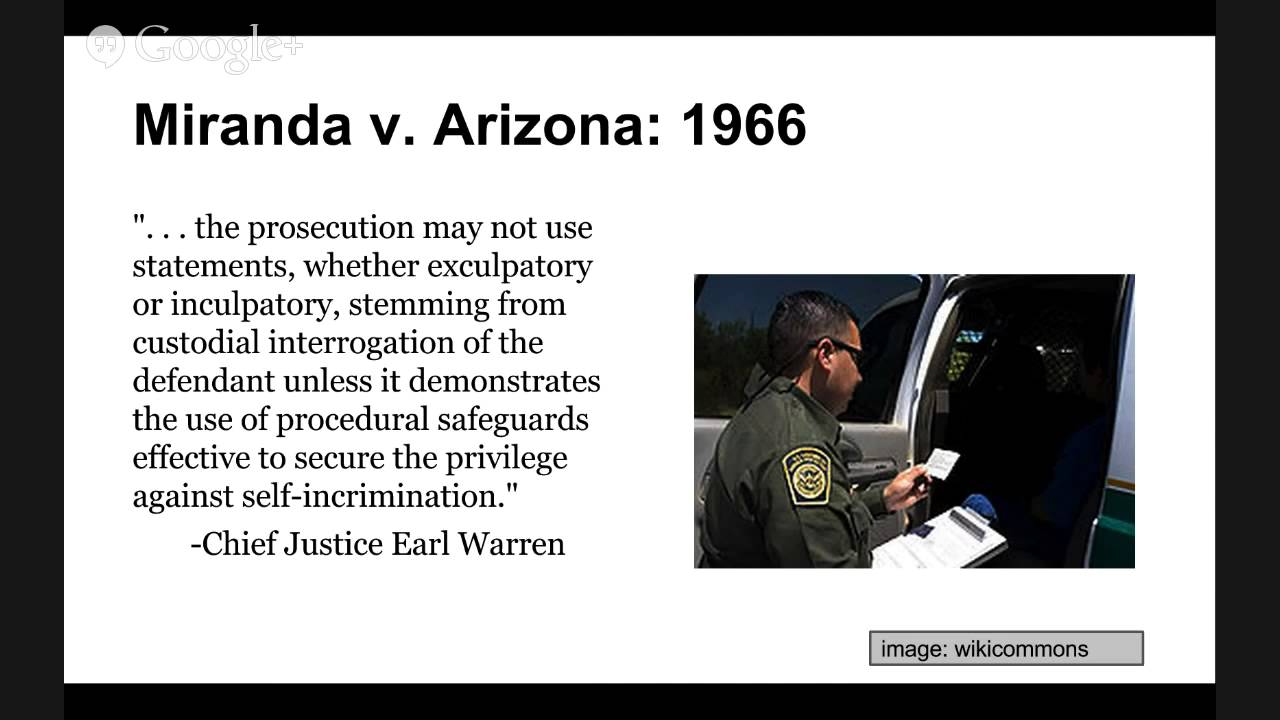
The Arizona Supreme Court. Chief Justice Earl Warren writing for a 54 majority held that prosecutors may not use statements made by suspects under questioning in police custody unless certain minimum procedural safeguards. Arizona This activity is based on the landmark Supreme Court case Miranda v. Arizona United States Supreme Court 1966 Case Summary of Miranda v. Miranda was not informed of his Fifth Amendment right to remain silent or right to have counsel present. In that case the Supreme Court had to decide under what circumstances police must inform people of their rights under the Constitutions Fifth and Sixth Amendments - and how to do so.
With Miranda as a foundation they compare similar cases decided by federal Courts of Appeals to identify when someone is actually in police custody and is entitled to a Miranda warning.
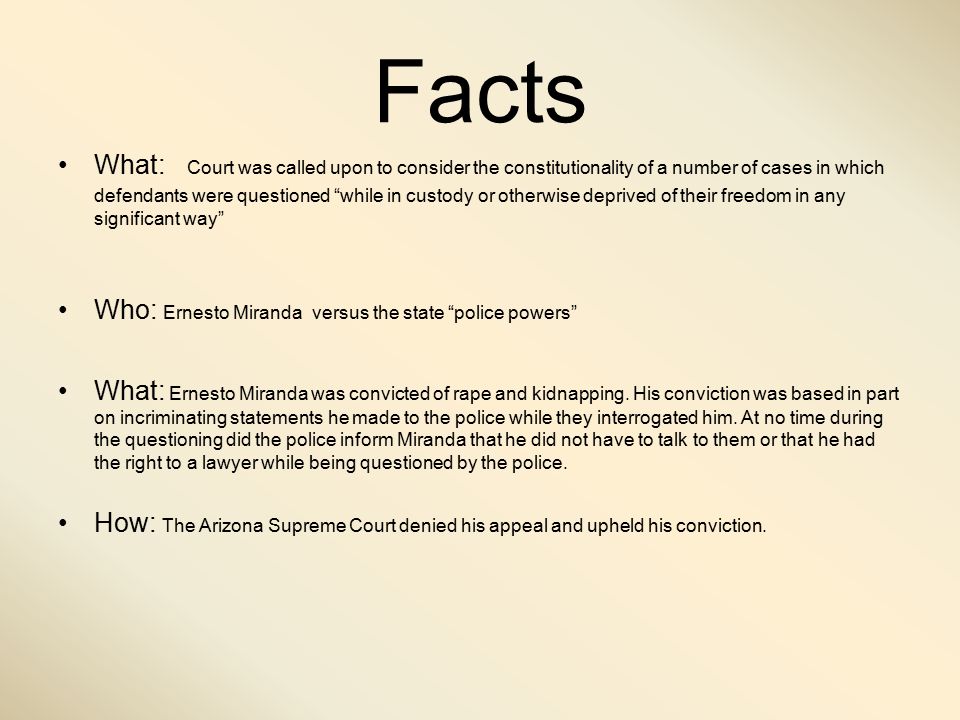
The Court found that the privilege against self-incrimination included in the Fifth Amendment was not preserved for. Self-incriminating evidence was provided by the. After investigation the police arrested Ernesto Miranda at his Phoenix home. Arizona the most important aspect of due process and criminal procedure ever affecting law enforcement and prosecutorial conduct of an investigation. ARIZONA 1966 CASE SUMMARY. Miranda was arrested for kidnapping and rape.
 Source: slideplayer.com
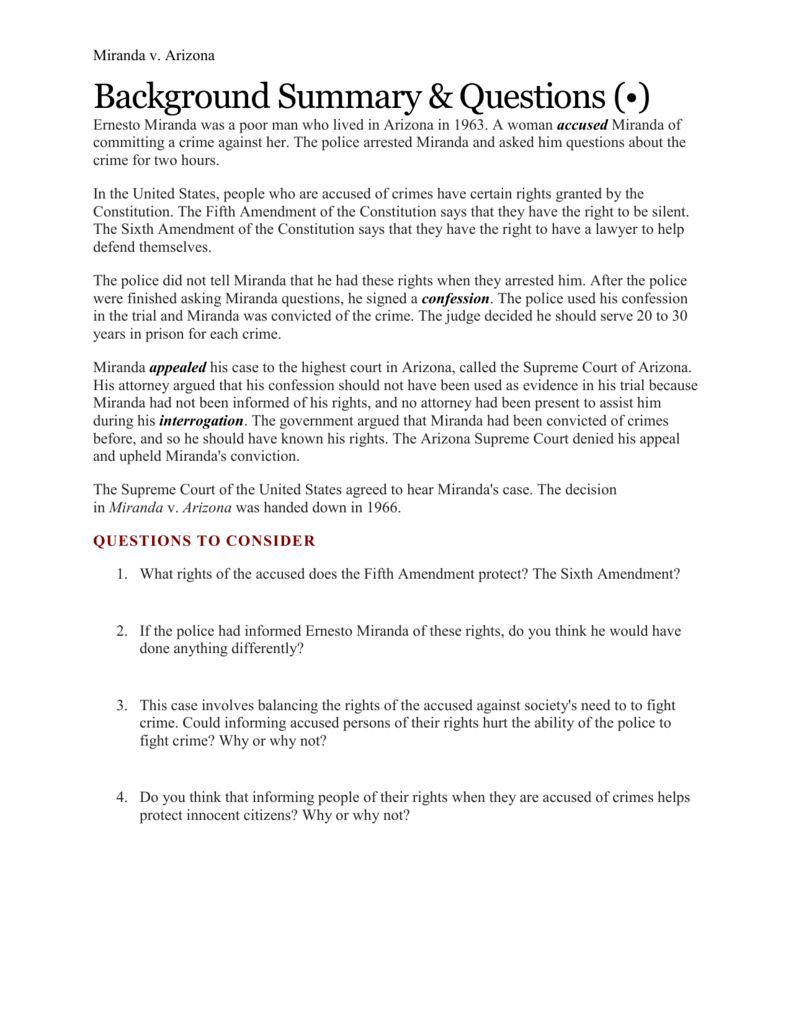
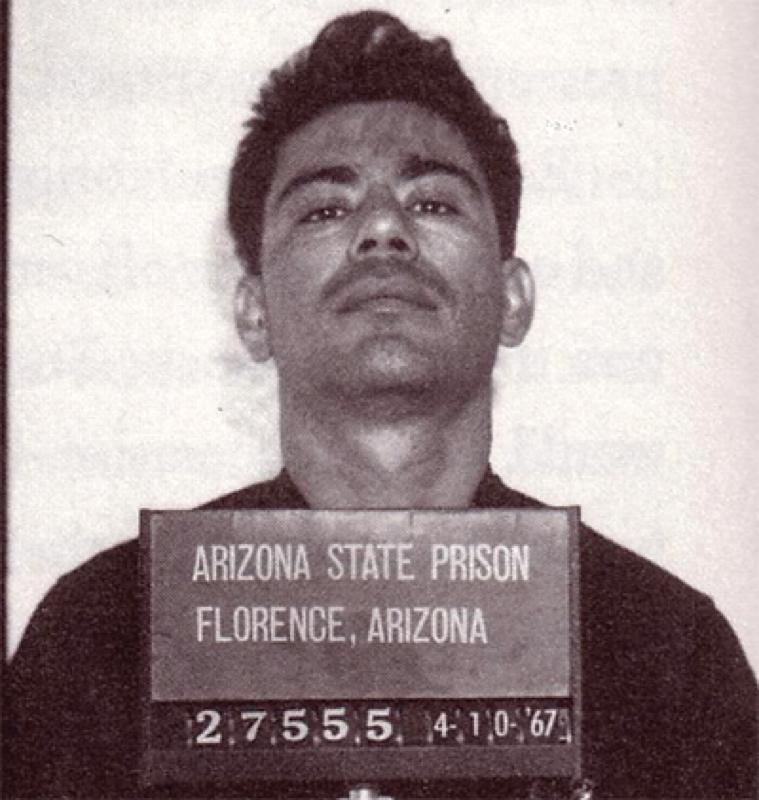
Half a Century Later by. Miranda appealed his conviction to the Arizona Supreme Court arguing that he was not informed of his Fifth and Sixth Amendment rights. In 1963 Ernesto Miranda was arrested at his home and taken in for questioning as the prime suspect of the kidnapping and rape of a young girlCase Brief Miranda v. The Arizona Supreme Court. Participants review a summary of the case and discuss it.
 Source: studylib.net
ARIZONA 1966 CASE SUMMARY. Miranda of his rights he signed a confession after two hours of investigation. Arizona United States Supreme Court 1966 Case Summary of Miranda v. Miranda was arrested for kidnapping and rape. 436 1966 United States Supreme Court case facts key issues and holdings and reasonings online today.
 Source: guides.loc.gov
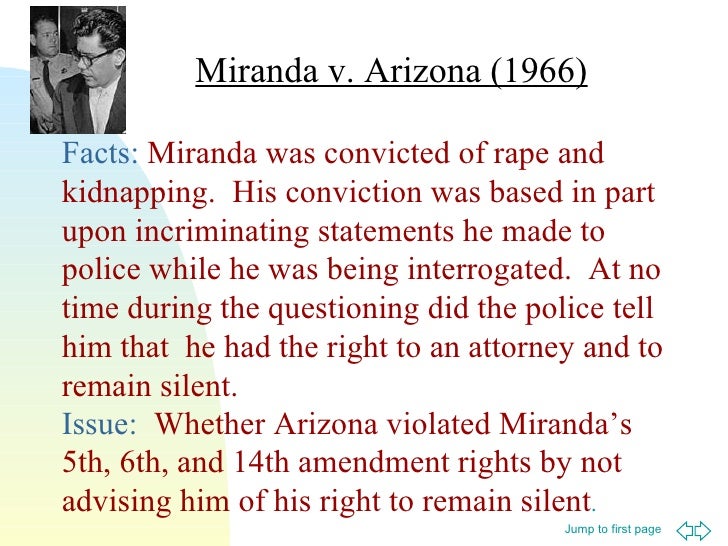
Evidence of each confession was used at trial. Miranda was arrested for kidnapping and rape. September 2nd 2014 I. Arizona 1966 the Supreme Court ruled that detained criminal suspects prior to police questioning must be informed of their constitutional right to an attorney and against. The main issues in this case were.
 Source: sites.gsu.edu
Trial and Miranda was sentenced to 2030 years in prison. Chief Justice Earl Warren writing for a 54 majority held that prosecutors may not use statements made by suspects under questioning in police custody unless certain minimum procedural safeguards. He was there identified by the complaining witness. 436 1966 United States Supreme Court case facts key issues and holdings and reasonings online today. The Court found that the privilege against self-incrimination included in the Fifth Amendment was not preserved for.
Source: tutor2u.net
2d 694 1966 Brief Fact Summary. The outcome of this case was the overturning of Mirandas conviction based on the finding that Miranda was not given appropriate warnings of his right to an attorney prior to questioning by the police and his ensuing confession. Miranda was taken into custody by police for purposes of interrogation where he later confessed. Arizona was a significant Supreme Court case that ruled that a defendants statements to authorities are inadmissible in court unless the defendant has been informed of their right to have an attorney present during questioning and an understanding that anything they say will be held against themIn addition for a statement to be admissible the. Miranda appealed his conviction to the Arizona Supreme Court arguing that he was not informed of his Fifth and Sixth Amendment rights.
 Source: slideshare.net
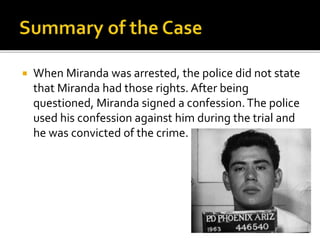
436 10 Ohio Misc. September 2nd 2014 I. The Arizona Supreme Court. Arizona In 1963 police in Arizona arrested Ernesto Miranda and took him to the station to question him. Miranda was an immigrant and although the officers did not notify Mr.
 Source: teacherspayteachers.com
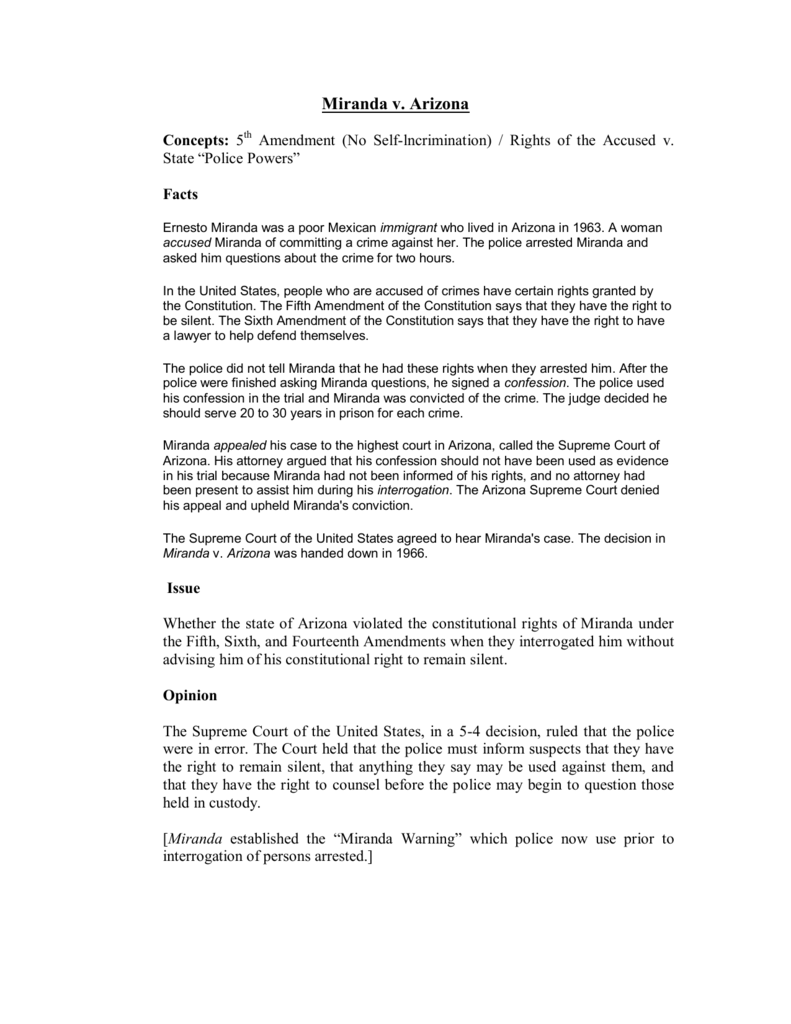
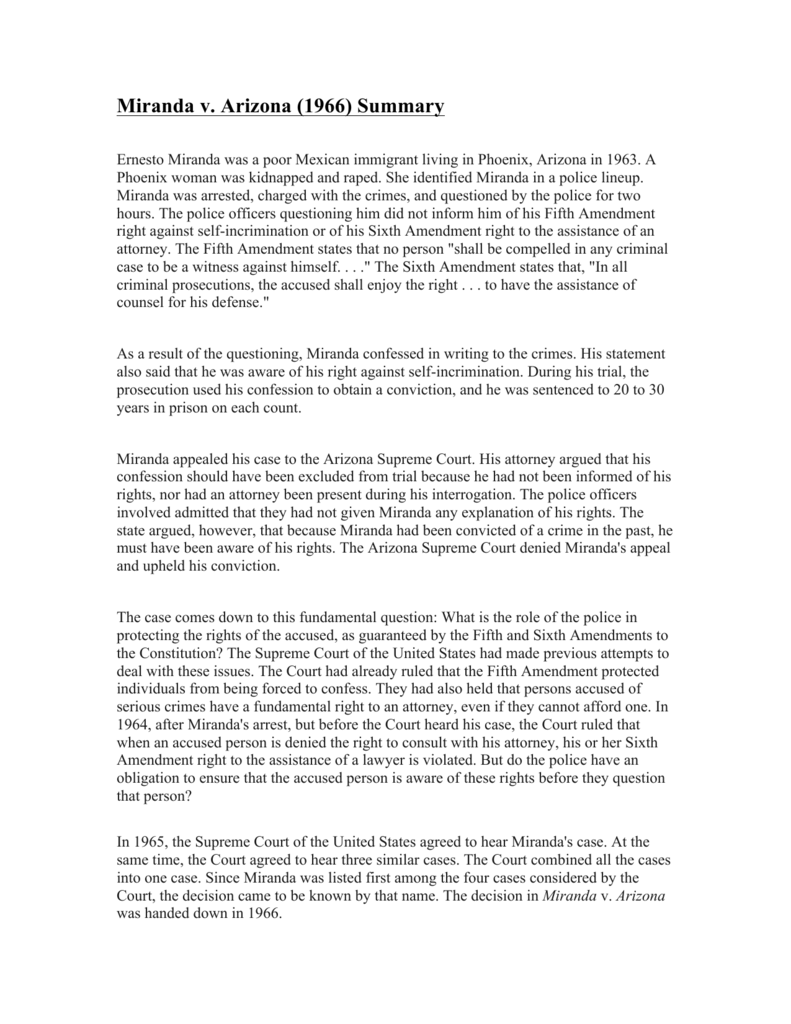
In March 1963 an 18-year-old female in Phoenix Arizona was kidnapped and raped. On March 13 1963 petitioner Ernesto Miranda was arrested at his home and taken in custody to a Phoenix police station. Arizona was a significant Supreme Court case that ruled that a defendants statements to authorities are inadmissible in court unless the defendant has been informed of their right to have an attorney present during questioning and an understanding that anything they say will be held against themIn addition for a statement to be admissible the. Arizona In 1963 police in Arizona arrested Ernesto Miranda and took him to the station to question him. Miranda was an immigrant and although the officers did not notify Mr.
 Source: guides.loc.gov
The officers admitted at trial that Miranda was not advised. Supreme Court deliberated the case Miranda v. Half a Century Later by. Self-incriminating evidence was provided by the. 436 1966 United States Supreme Court case facts key issues and holdings and reasonings online today.
 Source: rectoria.unal.edu.co
In 1963 Ernesto Miranda was arrested at his home and taken in for questioning as the prime suspect of the kidnapping and rape of a young girlCase Brief Miranda v. 436 1966 United States Supreme Court case facts key issues and holdings and reasonings online today. Arizona the most important aspect of due process and criminal procedure ever affecting law enforcement and prosecutorial conduct of an investigation. The signed statement included a statement that Mr. Half a Century Later by.
 Source: coursehero.com
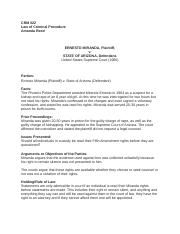
2d 694 1966 Brief Fact Summary. Arizona is a Supreme Court case that emphasizes the legal rights of the accused before an interrogation. After several hours of. Executive Summary In 1966 the US. There he was questioned by two police officers.
 Source: guides.loc.gov
At the police station Miranda was placed in a lineup. Chief Justice Earl Warren writing for a 54 majority held that prosecutors may not use statements made by suspects under questioning in police custody unless certain minimum procedural safeguards. The first Defendant Ernesto Miranda Mr. In March 1963 an 18-year-old female in Phoenix Arizona was kidnapped and raped. Half a Century Later by.
 Source: youtube.com
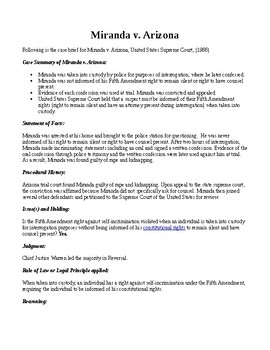
Miranda was not informed of his Fifth Amendment right to remain silent or right to have counsel present. At the police station Miranda was placed in a lineup. Arizona was a significant Supreme Court case that ruled that a defendants statements to authorities are inadmissible in court unless the defendant has been informed of their right to have an attorney present during questioning and an understanding that anything they say will be held against themIn addition for a statement to be admissible the. He was there identified by the complaining witness. Supreme Court on June 13 1966 established a code of conduct for police interrogations of criminal suspects held in custody.
 Source: studylib.net
On March 13 1963 petitioner Ernesto Miranda was arrested at his home and taken in custody to a Phoenix police station. Miranda was taken into custody by police for purposes of interrogation where he later confessed. Discover the case facts the. Miranda was not informed of his Fifth Amendment right to remain silent or right to have counsel present. In 1963 Ernesto Miranda was arrested at his home and taken in for questioning as the prime suspect of the kidnapping and rape of a young girlCase Brief Miranda v.
 Source: guides.loc.gov
Supreme Court deliberated the case Miranda v. The state agreed that the police did not warn Miranda of. Miranda Vs Arizona 1966 is a consolidation of four cases tried in the United States Supreme Court the decision of the Court on the issue of rights under Fifth amendment is regarded as a landmark judgement of its time it is by far the most cited case in American Criminal Proceedings History. Miranda appealed his conviction to the Arizona Supreme Court arguing that he was not informed of his Fifth and Sixth Amendment rights. However since he had been convicted of a crime before the court believed he already knew his rights.
 Source: slideplayer.com
Trial and Miranda was sentenced to 2030 years in prison. Arizona In 1963 police in Arizona arrested Ernesto Miranda and took him to the station to question him. The first Defendant Ernesto Miranda Mr. Half a Century Later by. The main issues in this case were.
 Source: studylib.net
The warning comes from a 1966 Supreme Court case Miranda v. 436 10 Ohio Misc. The warning comes from a 1966 Supreme Court case Miranda v. Miranda Vs Arizona 1966 is a consolidation of four cases tried in the United States Supreme Court the decision of the Court on the issue of rights under Fifth amendment is regarded as a landmark judgement of its time it is by far the most cited case in American Criminal Proceedings History. Miranda was an immigrant and although the officers did not notify Mr.
 Source: slsi.lk
Arizona legal case in which the US. Executive Summary In 1966 the US. 2d 694 1966 Brief Fact Summary. Arizona United States Supreme Court 1966 Case Summary of Miranda v. The outcome of this case was the overturning of Mirandas conviction based on the finding that Miranda was not given appropriate warnings of his right to an attorney prior to questioning by the police and his ensuing confession.
 Source: academia.edu
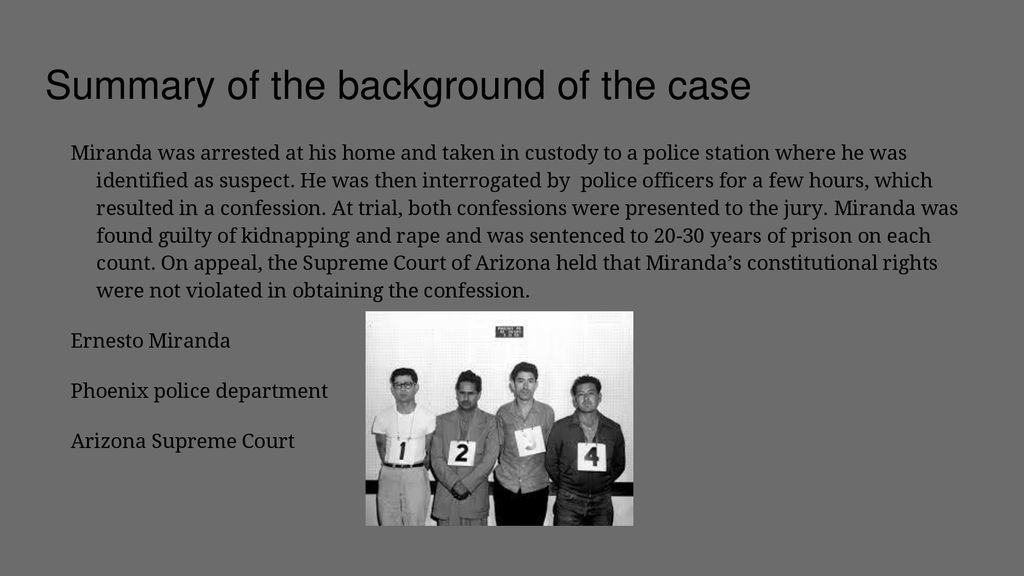
Background of the Case The Supreme Courts decision was a consolidation of four cases. Background of the Case The Supreme Courts decision was a consolidation of four cases. However since he had been convicted of a crime before the court believed he already knew his rights. Miranda was not informed of his Fifth Amendment right to remain silent or right to have counsel present. Miranda was aware of his rights.
This site is an open community for users to share their favorite wallpapers on the internet, all images or pictures in this website are for personal wallpaper use only, it is stricly prohibited to use this wallpaper for commercial purposes, if you are the author and find this image is shared without your permission, please kindly raise a DMCA report to Us.
If you find this site good, please support us by sharing this posts to your preference social media accounts like Facebook, Instagram and so on or you can also save this blog page with the title miranda v arizona case summary by using Ctrl + D for devices a laptop with a Windows operating system or Command + D for laptops with an Apple operating system. If you use a smartphone, you can also use the drawer menu of the browser you are using. Whether it’s a Windows, Mac, iOS or Android operating system, you will still be able to bookmark this website.