Your Lee v weisman summary images are available. Lee v weisman summary are a topic that is being searched for and liked by netizens now. You can Find and Download the Lee v weisman summary files here. Get all free photos and vectors.
If you’re looking for lee v weisman summary pictures information related to the lee v weisman summary topic, you have come to the right site. Our site frequently provides you with hints for seeing the highest quality video and image content, please kindly search and find more enlightening video content and images that match your interests.
Lee V Weisman Summary. Synopsis of Rule of Law. It was the first major school prayer case decided by the Rehnquist Court. In Lee v. Lee a middle school principal invited a rabbi to speak at his schools graduation ceremony.
 Lee V Weisman By Minsung Kim On Prezi Next From prezi.com
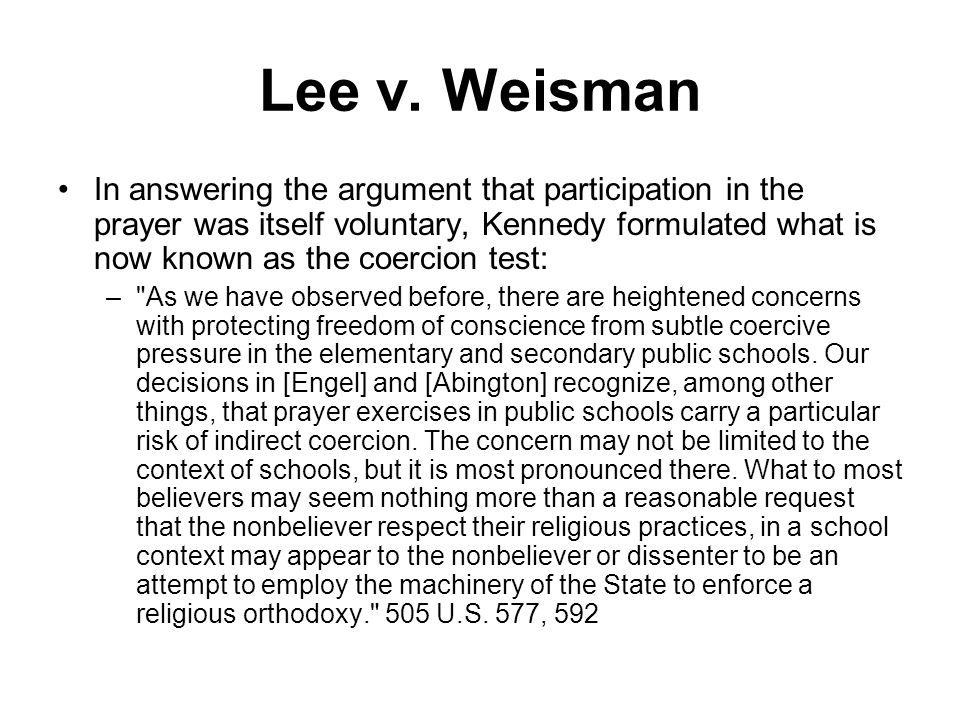
Weisman was the most important decision of the 199192 term involving the much vexed question of the role of religion in American lifeThe case involved the practice by the Nathan Bishop Middle School of Providence Rhode Island of inviting members of the clergy to offer prayers at graduation ceremonies. Along with the criticism of the majority Courts opinion Justice Scalia also mentioned the benefit of prayers. In Lee v. In keeping with the practice of several other public middle and high school principals in Providence Rhode Island Robert E. Weisman case in which the US. In 1989 Robert E.
Lee a middle school principal invited a rabbi to speak at his schools graduation ceremony.
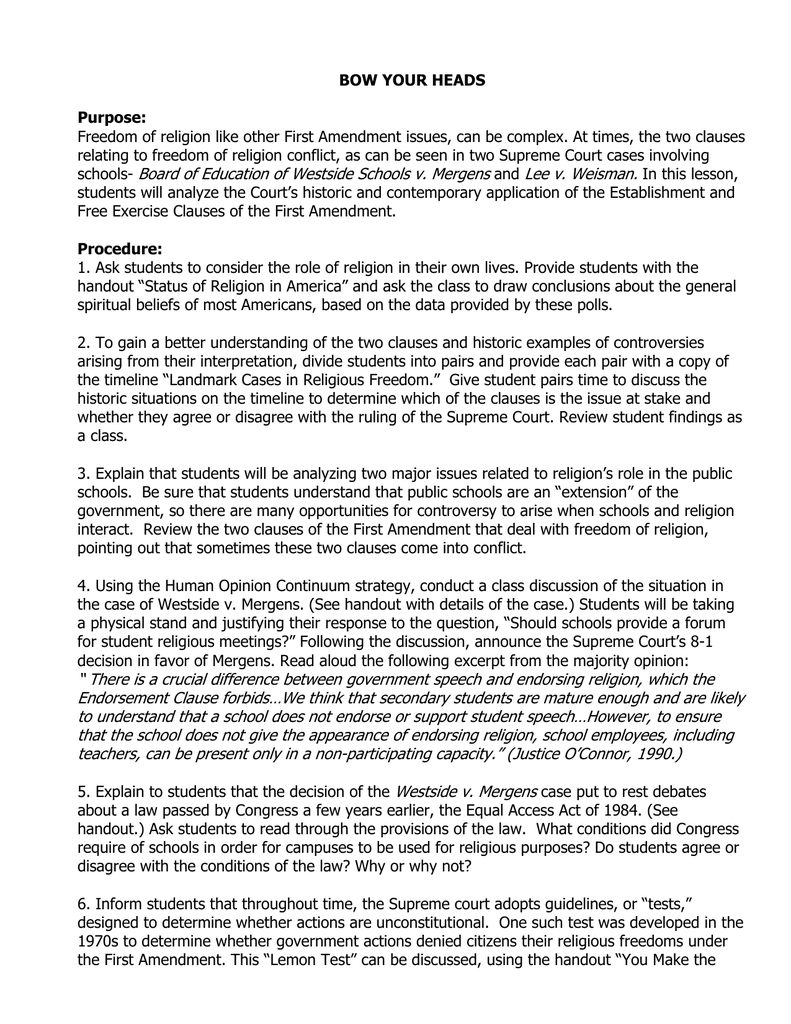
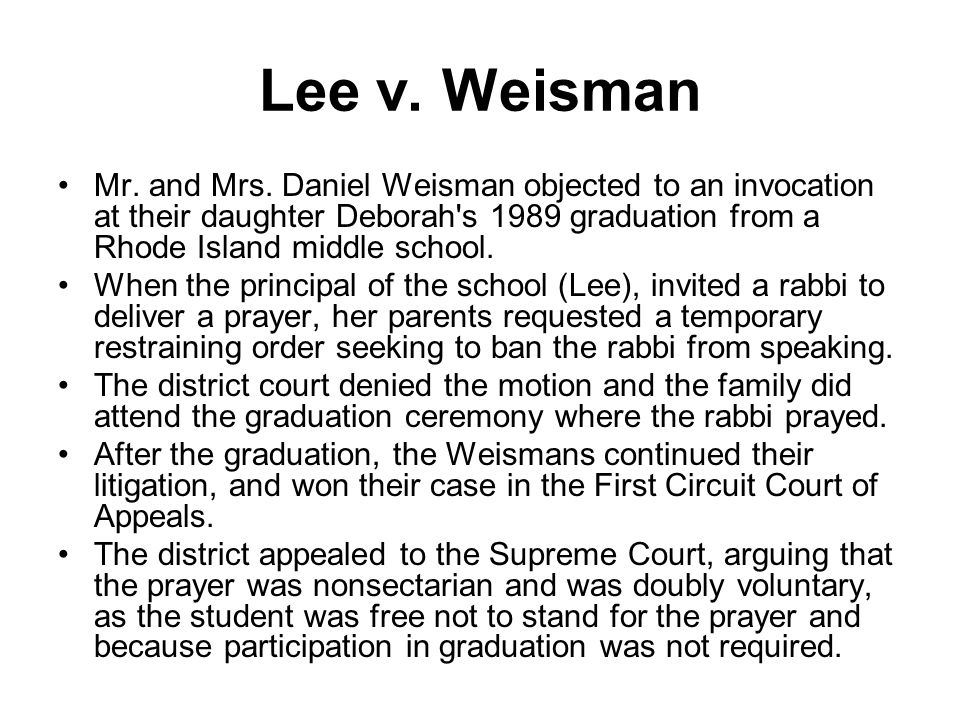
Weismen the Supreme Court ruled that it was unconstitutional for a public school in Rhode Island to have a member of the clergy deliver a prayer at graduation ceremonies. Petitioner Lee a middle school principal invited a rabbi to offer such prayers at the graduation ceremony for Deborah Weismans class gave the Rabbi a pamphlet containing guidelines for the composition of public prayers at civic ceremonies and advised him that the prayers should be nonsectarian. In Lee v. Shortly before the ceremony the District Court denied the motion of respondent. The court held that it violated the First Amendment s establishment clause which generally prohibits the government from. Deborah Weisman graduated from Nathan Bishop Middle School a public school in Providence at a formal ceremony in June 1889.
 Source: slideplayer.com
Shortly before the ceremony the District Court denied the motion of respondent. Summary of Key Facts A. Many schools have traditionally had someone offer prayers at important school events like graduations but critics argue that such prayers violate the separation of church and state because they mean that the government is endorsing particular religious beliefs. Facts of the case In keeping with the practice of several other public middle and high school principals in Providence Rhode Island Robert E. Facts of the Case Lee vs.
 Source: docplayer.net
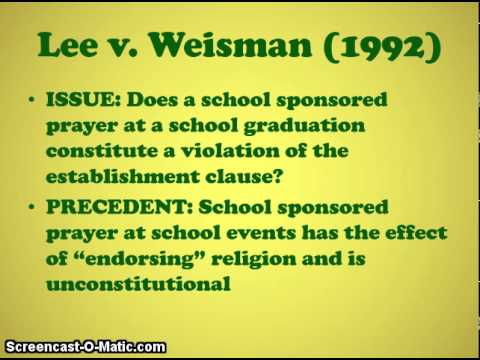
Get more case briefs explained with Quimbee. Weisman brought suit in district court seeking a restraining order to prevent a rabbi from delivering prayer at his daughters middle school graduation. Deborah Weisman Defendant alleges that a school sponsored non-denominational prayer offered at a public school graduation violated the Establishment Clause. In 1992 the Supreme Court reaffirmed its interpretation of the Establishment Clause written in Engel. In 1989 Robert E.
 Source: slidetodoc.com
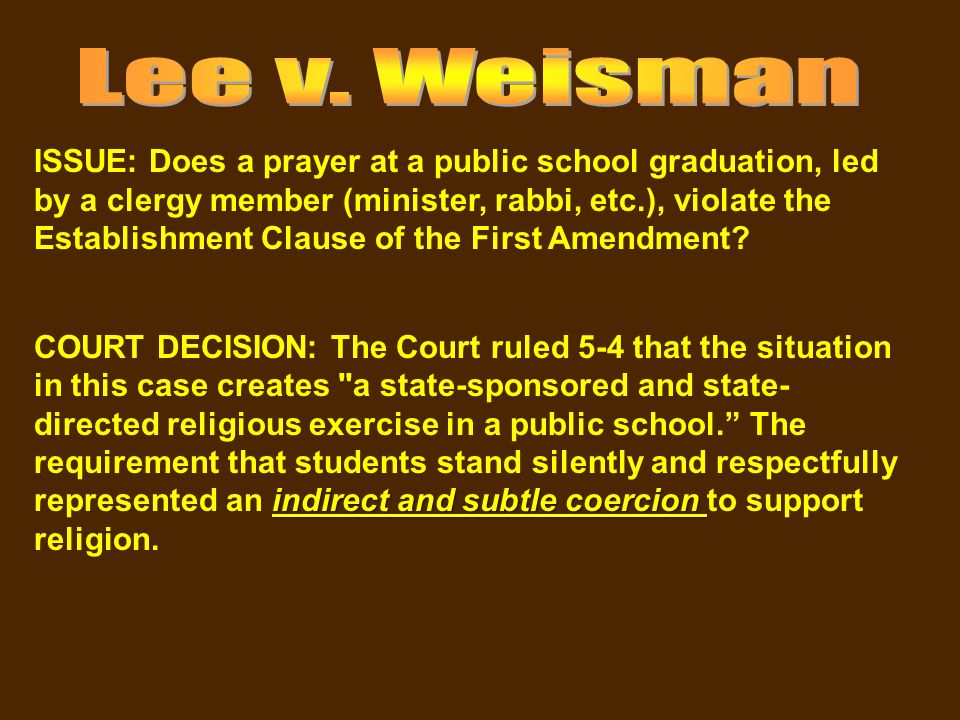
In this instance a student Deborah Weisman and her. Along with the criticism of the majority Courts opinion Justice Scalia also mentioned the benefit of prayers. In Lee v. Supreme Court on June 24 1992 ruled 54 that it was unconstitutional for a public school in Rhode Island to have a member of the clergy deliver a prayer at graduation ceremonies. Lee principal of Nathan Bishop Middle School invited a rabbi to deliver the prayers at their graduation ceremony.
 Source: studylib.net
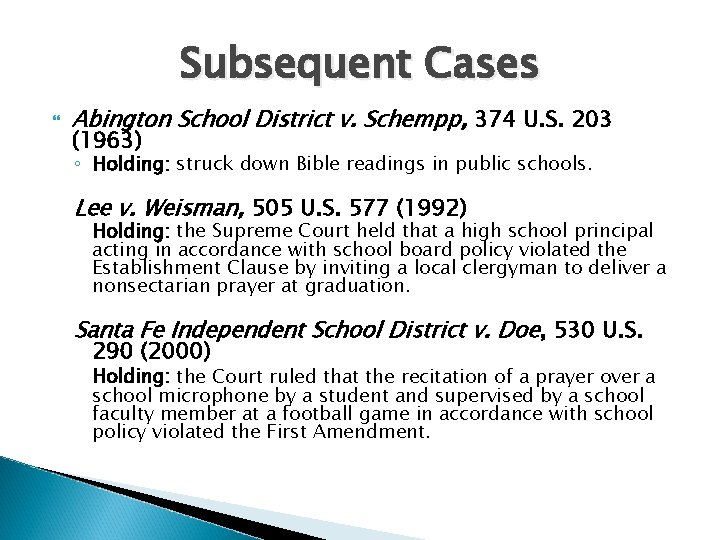
Lee a middle school principal invited a rabbi to speak at his schools graduation ceremony. Facts of the case In keeping with the practice of several other public middle and high school principals in Providence Rhode Island Robert E. In keeping with the practice of several other public middle and high school principals in Providence Rhode Island Robert E. 2d 467 1992. Weisman 1992 ruled that public schools violate the Establishment Clause of the First Amendment when they lead students in public prayer at school events.
 Source:
Shortly before the ceremony the District Court denied the motion of respondent. Lee v Weisman Video Duke Law Decided June 24 1992 JUSTICE KENNEDY delivered the opinion of the Court. Hoping to stop the rabbi from speaking at his daughters graduation Weisman sought a. Lee a middle school principal invited a rabbi to speak at his schools graduation ceremony. Justice Scalia suggested that the occasion of civic prayer in the middle school graduation ceremony trained citizens to respect the religious beliefs of others.
 Source: slideplayer.com
Weisman 1992 ruled that public schools violate the Establishment Clause of the First Amendment when they lead students in public prayer at school events. It held that schools may not sponsor clerics to conduct even non-denominational prayer. Daniel Weismans daughter Deborah was. Weismen the Supreme Court ruled that it was unconstitutional for a public school in Rhode Island to have a member of the clergy deliver a prayer at graduation ceremonies. Petitioner Lee a middle school principal invited a rabbi to offer such prayers at the graduation ceremony for Deborah Weismans class gave the rabbi a pamphlet containing guidelines for the composition of public prayers at civic ceremonies and advised him that the prayers should be nonsectarian.
 Source: slideplayer.com
Weisman claimed it violated the First Amendment s Establishment Clause and the federal district court denied the injunction. Lee v Weisman 505 US 577. He argued maintaining respect for the religious observations of others is a. Supreme Court on June 24 1992 ruled 54 that it was unconstitutional for a public school in Rhode Island to have a member of the clergy deliver a prayer at graduation ceremonies. Weisman was the most important decision of the 199192 term involving the much vexed question of the role of religion in American lifeThe case involved the practice by the Nathan Bishop Middle School of Providence Rhode Island of inviting members of the clergy to offer prayers at graduation ceremonies.
 Source: youtube.com
He argued maintaining respect for the religious observations of others is a. School principals in the public school system of the city of Providence Rhode Island are permitted to invite members of the clergy to offer invocation and benediction prayers as part of the formal graduation ceremonies for middle schools and for. 2d 467 1992. Weisman 1992 ruled that public schools violate the Establishment Clause of the First Amendment when they lead students in public prayer at school events. Daniel Weisman plaintiff whose daughter was among the expected graduates sought a temporary restraining order in federal district court to prevent the rabbi from speaking at the graduation.
 Source: slideplayer.com
Lee principal of Nathan Bishop Middle School invited a rabbi to deliver the prayers at their graduation ceremony. Summary of Key Facts A. Daniel Weismans daughter Deborah was among the graduates. Shortly before the ceremony the District Court denied the motion of respondent. He argued maintaining respect for the religious observations of others is a.
 Source: slideplayer.com
Lee a middle school principal invited a rabbi to speak at his schools graduation ceremony. Shortly before the ceremony the District Court denied the motion of respondent. Daniel Weismans daughter Deborah was among the graduates. Synopsis of Rule of Law. Weisman claimed it violated the First Amendment s Establishment Clause and the federal district court denied the injunction.
 Source: youtube.com
Lee defendant a public middle school principal invited a Jewish rabbi to say prayers at his schools graduation ceremony. Lee defendant a public middle school principal invited a Jewish rabbi to say prayers at his schools graduation ceremony. Weisman Brief Citation505 US. 2d 467 1992 US. Lee principal of Nathan Bishop Middle School invited a rabbi to deliver the prayers at their graduation ceremony.
 Source: slideplayer.com
Lee a middle school principal invited a rabbi to speak at his schools graduation ceremony. Many schools have traditionally had someone offer prayers at important school events like graduations but critics argue that such prayers violate the separation of church and state because they mean that the government is endorsing particular religious beliefs. Lee defendant a public middle school principal invited a Jewish rabbi to say prayers at his schools graduation ceremony. His request was denied and the rabbi. Supreme Court on June 24 1992 ruled 54 that it was unconstitutional for a public school in Rhode Island to have a member of the clergy deliver a prayer at graduation ceremonies.
 Source: quimbee.com
In this instance a student Deborah Weisman and her. In this instance a student Deborah Weisman and her. Daniel Weismans daughter Deborah was. He was provided with the pamphlet Guidelines for Civic. Weisman was the most important decision of the 199192 term involving the much vexed question of the role of religion in American lifeThe case involved the practice by the Nathan Bishop Middle School of Providence Rhode Island of inviting members of the clergy to offer prayers at graduation ceremonies.
 Source: slideplayer.com
Shortly before the ceremony the District Court denied the motion of respondent. He was provided with the pamphlet Guidelines for Civic. Daniel Weismans daughter Deborah was among the graduates. Weisman 1992 ruled that public schools violate the Establishment Clause of the First Amendment when they lead students in public prayer at school events. Petitioner Lee a middle school principal invited a rabbi to offer such prayers at the graduation ceremony for Deborah Weismans class gave the rabbi a pamphlet containing guidelines for the composition of public prayers at civic ceremonies and advised him that the prayers should be nonsectarian.
 Source: 69279823.weebly.com
Lee a middle school principal invited a rabbi to speak at his schools graduation ceremony. Facts of the Case Lee vs. Facts of the case In keeping with the practice of several other public middle and high school principals in Providence Rhode Island Robert E. Many schools have traditionally had someone offer prayers at important school events like graduations but critics argue that such prayers violate the separation of church and state because they mean that the government is endorsing particular religious beliefs. Daniel Weisman plaintiff whose daughter was among the expected graduates sought a temporary restraining order in federal district court to prevent the rabbi from speaking at the graduation.
 Source: teachingamericanhistory.org
Petitioner Lee a middle school principal invited a rabbi to offer such prayers at the graduation ceremony for Deborah Weismans class gave the rabbi a pamphlet containing guidelines for the composition of public prayers at civic ceremonies and advised him that the prayers should be nonsectarian. Summary of Key Facts A. Along with the criticism of the majority Courts opinion Justice Scalia also mentioned the benefit of prayers. Weisman was the most important decision of the 199192 term involving the much vexed question of the role of religion in American lifeThe case involved the practice by the Nathan Bishop Middle School of Providence Rhode Island of inviting members of the clergy to offer prayers at graduation ceremonies. Shortly before the ceremony the District Court denied the motion of respondent.
Source: prezi.com
His request was denied and the rabbi. Deborah Weisman graduated from Nathan Bishop Middle School a public school in Providence at a formal ceremony in June 1889. Justice Scalia suggested that the occasion of civic prayer in the middle school graduation ceremony trained citizens to respect the religious beliefs of others. Deborah Weisman Defendant alleges that a school sponsored non-denominational prayer offered at a public school graduation violated the Establishment Clause. Along with the criticism of the majority Courts opinion Justice Scalia also mentioned the benefit of prayers.
 Source: slideplayer.com
The court held that it violated the First Amendment s establishment clause which generally prohibits the government from. Weisman Brief Citation505 US. Lee v Weisman Video Duke Law Decided June 24 1992 JUSTICE KENNEDY delivered the opinion of the Court. Daniel Weismans daughter Deborah was among the graduates. Facts of the case In keeping with the practice of several other public middle and high school principals in Providence Rhode Island Robert E.
This site is an open community for users to do sharing their favorite wallpapers on the internet, all images or pictures in this website are for personal wallpaper use only, it is stricly prohibited to use this wallpaper for commercial purposes, if you are the author and find this image is shared without your permission, please kindly raise a DMCA report to Us.
If you find this site beneficial, please support us by sharing this posts to your own social media accounts like Facebook, Instagram and so on or you can also bookmark this blog page with the title lee v weisman summary by using Ctrl + D for devices a laptop with a Windows operating system or Command + D for laptops with an Apple operating system. If you use a smartphone, you can also use the drawer menu of the browser you are using. Whether it’s a Windows, Mac, iOS or Android operating system, you will still be able to bookmark this website.


